From the recollections of participants in the defense of Luhansk Airport
Approximately 80% of the text of the book In the Ring of Fire: Defense of Luhansk Airport consists of quotes from direct participants in the events described. Here are some of them.
About life and daily routine at the surrounded airport
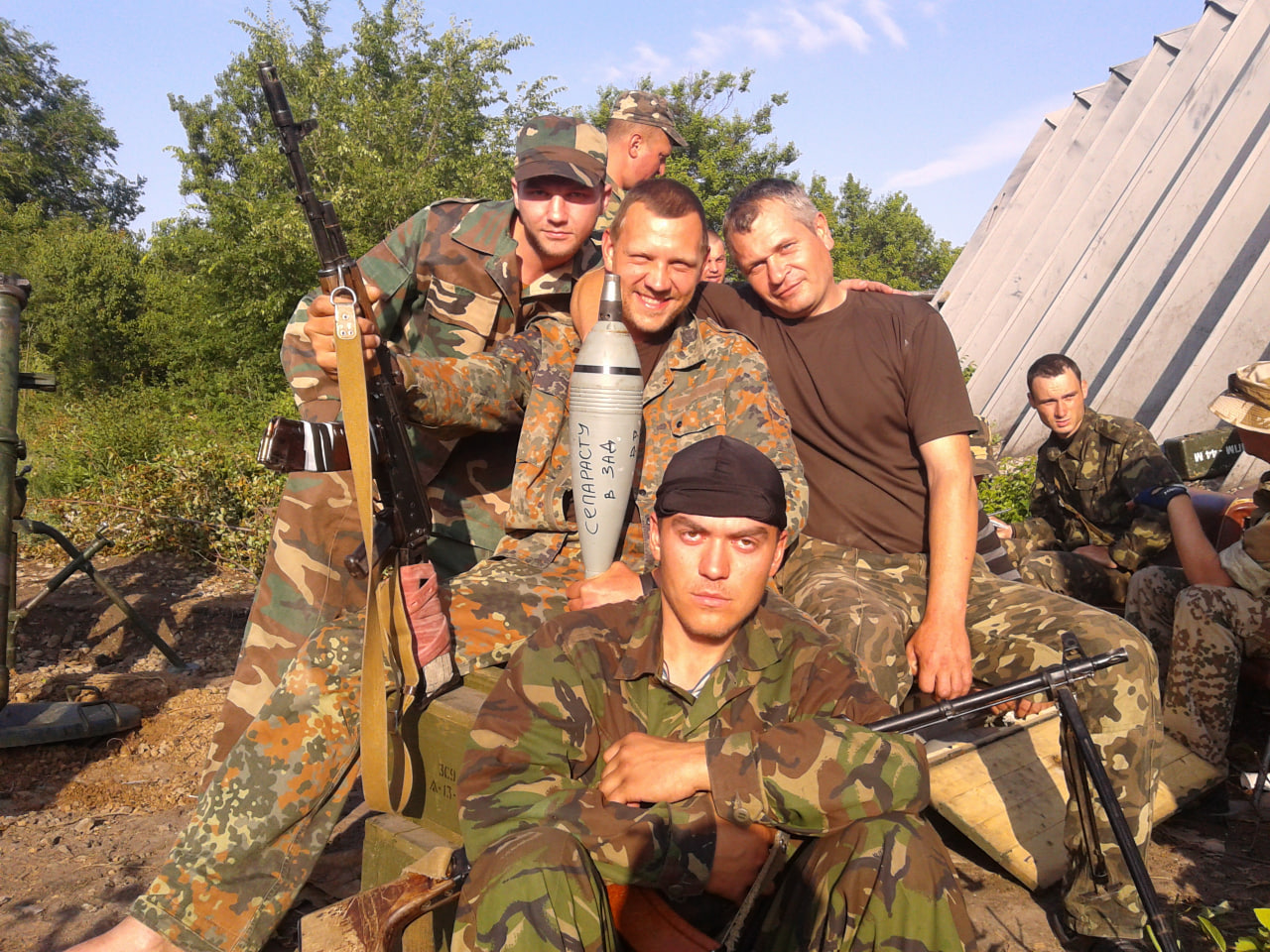
Soldiers of the 25th Airborne Brigade and Viktor Kuznietsov at Luhansk Airport, June 2014
“We had a very unpleasant feeling of so-called operational encirclement. Knowing that the road leading to Shchastia through the fields wasn’t all that reliable and could be cut off any moment, leaving us completely surrounded. Full encirclement is a very unpleasant thing. We were used to shelling, used to going to the bathroom fast because you might not come back. But this constant feeling that you could be trapped in a cauldron was the most unsettling. When you’re under constant shelling, you’re kind of ready for it. Maybe some people can cope with this feeling. But it was hard for me. So, we tried our best, we kept working – as the day of our departure approached, there were more and more wounded…”
“[After the power plant was hit] we were left without electricity and water because the pump stopped working. We walked around Luhansk Airport and found two water tanks. What to do with it? Should we boil it? What’s the point? So, you would just grab a cup, scoop some, see a carp swimming there, drink up. Look at the carp some more, if only there was a fishing rod… Well, you know. We drank the water as it was, no one got sick, no one even caught anything from that water. It was pitch black. The only good thing about it was that frogs don’t actually swim in dirty water. There were a few frogs there, so the water was clean, all right. Safe to drink.”
“How did we wash ourselves? Well… Say, you walk outside, and it starts raining. You rush back at once and scream, at the top of your lungs: “Showeeeer!!!” And then you’d see a crowd of men hurrying outside to take one. Well, everyone’s clean as a whistle, what’s next? And next is drying off, which was kind of a problem, because the water is soft, and no matter how much you rub yourself, it doesn’t feel right. That’s the kind of showers we had.
Then there were basins and buckets; you’d fill a reservoir, wash yourself up next to it, and move along. Atta boy! You would also wanna do your laundry when it rained because there was no other water.
An interesting moment. Our nation is probably the only one that could come up with something like this: hangars for planes with ribbed roofs, like triangles. The roof is triangular, and it’s covered with a triangle as well. We cut a hole in it, inserted gutters. When it rained, water flowed into a barrel from all the roofs. So, we could wash up and do laundry. Everybody wanted a nice bath; one and a half liters per person a day was barely enough for drinking and cooking, say nothing of washing, … that was all the water you had. So, we came up with this: when it rains, water runs into barrels. Sometimes, you’d set a barrel in the evening, it would rain the whole night, and in the morning, the barrel would be empty. Someone would come at night, drain it, and take your water. Someone would already have their uniform washed!”
“I remember celebrating a birthday there. We were invited to a birthday party. We came over, congratulated the guy, all nice and fine, just as it should be, and they gave us some meat to try. We tried it and asked, “Where did you get the chicken?” And they said, “It’s no chicken, it’s a snake.” It was tasty. Something to gnaw on, it’ll do.
When we found ourselves surrounded, we tightened our belts, we had to be smarter than that. That’s how I first tried snake meat in the army. We even had three species. I don’t know how they are actually called – one was long, we called it “python” because it was over two meters long with a reddish tint. That’s what I tried [the first time]. Snakes were everywhere – we were catching them at checkpoints, the guys from the 80th Brigade as well. They all tasted the same, one or the other. I don’t even know what it can be compared to, for someone who never tried it. It had a bit of an oily taste.”
“Once, there was a moment when we cooked a pot of borscht in the morning, but it stood untouched until night because we had no time to eat [due to shelling]. And when we finally sat down to eat in the evening, there were pieces of metal tinkling inside – shrapnel, you see. They fell into our borscht, from explosions. No one thought of hiding the borscht, we had to hide our own heads to survive. So, this was our “combat borscht”.”
“The shelling was intensifying. We broke through, but the ring closed again. We found ourselves in the same trap as our friends. Ammo was running out. An An-30 reconnaissance plane dropped supplies to us from an altitude of 5,500 meters – ammo, fuel in barrels. At one point, the plane was shot down. The situation was bleak: we were surrounded, almost out of food, drinking water from sedimentation tanks. …”
About shelling, fighting, and military operations
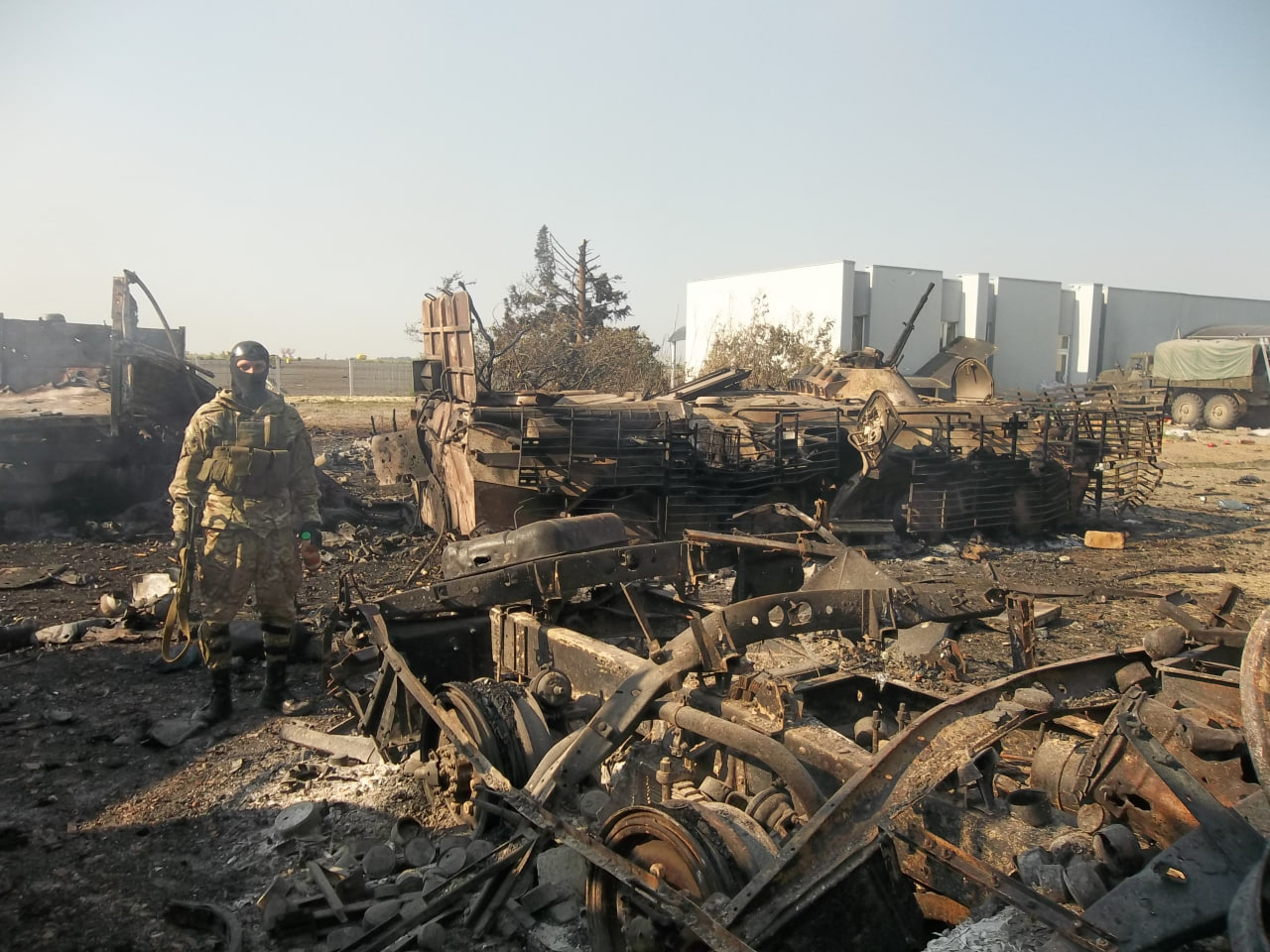
Damaged equipment at Luhansk Airport, August 2014
We suffered losses in equipment, and we had few personnel left. We were told: “Guys, you have to hold on, or was it all for nothing, our comrades gave their lives, you have to hold on, reinforcements will come soon, just one more night…”
… RGD grenades were exploding all over the place, but honestly, that didn’t bother us at all: we would get down – just another explosion, no one even wounded. At such moments, you get that “25th frame” feeling or something, it felt like time slowed down a bit, I would clearly see an RGD flying, and I would see it was flying right here, at us. I couldn’t run out and around the house, I would have run right into their firing sector, and the only thing left, for me and the guys, was to fall to the ground and pray. We all got down, and I started counting in my head: 501, 502, like when you jump with a parachute, I’m counting: 501, 502, 503, 504… I keep looking at that grenade, and it’s just lying there and that’s it. It didn’t explode, and I said that, once again, Good Lord saved us, he was looking out for us, very, very carefully… That’s it. We were told to hold on – we retreated
“Every single day they were shelling us from 11 a.m. to noon, then they started hitting at night, from 4 a.m. to 5 a.m.
We had a radio, and we would listen to what they were saying. We overheard a conversation between two so-called officials once: “Sleeping on the job? Look at the time, not a single shot at the airport, what are you thinking?” Back then, there were one or two launchers, but the guys were told there were four. So, they would fire half a package, adjust, then fire again – we knew we had at least half an hour while they were reloading [the launcher]. But they would run away immediately, so, during the day it was quiet. Our artillery fired at all the points they were shooting from, but you know, there are nuances, you might have little time to bring down fire on that square.”
“After the battles, when we would take weapons from the killed seps to destroy them, we saw that not all the weapons were Ukrainian. There were many samples of Russian-made weapons. The weapons were modern, not from the Soviet era, mostly manufactured in the 1990s and sometimes the early 2000s. It was very evident that there was a significant presence and “help,” as they called it, from the “brotherly” nation.
… But we also understood that they [the Russians] were rarely “pushing it” like that at first. They would try to avoid direct contacts and direct fights. Their artillery mostly worked from afar.
… Back before the war, we couldn’t even think [that we would have to fight Russian paratroopers]. Many guys in the Ukrainian Armed Forces would keep in touch with Russian paratroopers on social networks, message each other, exchange greetings on holidays, send each other videos and photos. But now… Now it was what it was.”
“The Pskov paratroopers misled the brigade. The entire brigade tactical group moved towards Heorhiivka–Khriashchuvate area, and this was a trap set up by the Russian troops – an attack on that checkpoint, followed by an organized retreat. In our experience, we hadn’t faced anything like this before, and we (the brigade tactical group) followed them. And they began to encircle the brigade forces. One of my soldiers saw through a telescope (a little something brought by volunteers; sure, military optical devices would have been much better, but we tried to get the most of whatever civilian devices we had) mortars and four tanks moving from one side. I immediately ordered to start shelling. We were 9 kilometers away from them, and our mortars could only shoot up to 7,900 meters, but even though we couldn’t reach them, the fear factor worked – they got scared of being shelled. And they wouldn’t get any closer. We waited for the heavy artillery to arrive, and once it did, would shell them with everything we had.
This happened in the morning, and by noon, the 8th Regiment of Special Forces was already driving around, collecting the so-called trophy weapons and vehicles. There were also those soldiers there – a sergeant and five other lads (if I’m not mistaken). The SSU took them right away; we didn’t even have time to get any valuable information from them. But we had all the technical documentation for their equipment, personal belongings, and papers. These were Pskov paratroopers.”
About the support from local residents
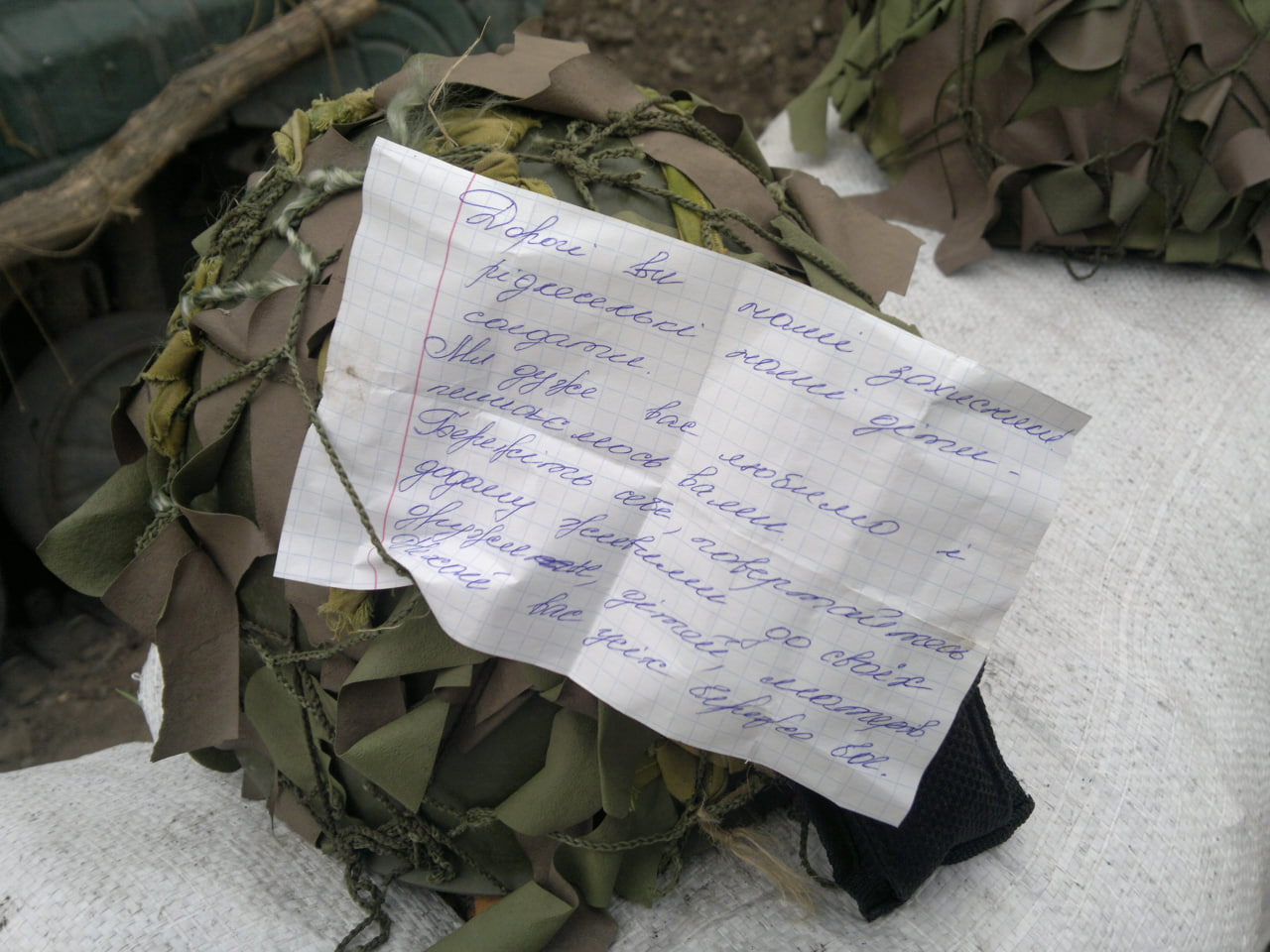
Letter to Ukrainian soldiers with words of support from local residents, August 18, 2014
(Letter text in Ukrainian: “Our dear defenders, our beloved children-soldiers. We love you very much and we are proud of you. Take care of yourselves and come home alive to your wives, children and mothers. God bless you all.”)
“People were sharing everything with us so sincerely. We saw that they were giving away nearly the last they had. They were bringing all kinds of things – directly to the position. Old ladies would come bringing some apples, homemade preserves. There were many nice people. Unfortunately, in the territories we have already lost, people who were helping us were being executed. Volunteers from Luhansk, Heorhiivka, Lutuhyne. Many people were killed there. They were taken out and executed en masse.”
“I still have the image in my mind of us driving through those areas, that terrible heat, we’re parched, and there is that old lady running after us, carrying apples. Apples meant water. And we tried to save water for drinking and washing.”
“When we stood in Lutuhyne for a month, we were building up intelligence. Many locals were supporting Ukraine, and many were helping us, and many were working for us. According to some reports, after we left and the Russians came in, about forty families were executed. They killed so many people, just for helping Ukraine. We still have friends there, and we keep in touch.”
About injuries and medical care
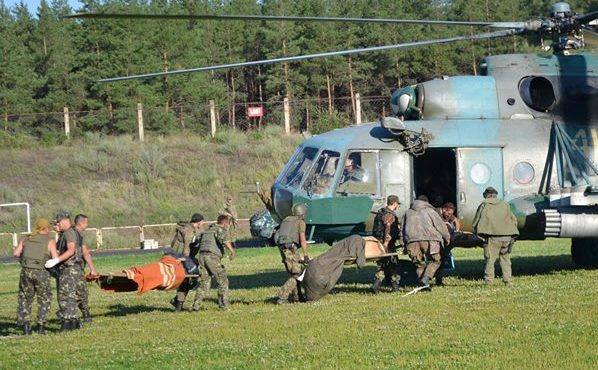
Evacuation of the wounded and dead, July 21, 2014
“Those who could be taken out immediately were evacuated. Usually, the best time for evacuation was around 4–5 in the morning when the other side, let’s say, was changing shifts or had tired a bit overnight, and the intensity of the shelling decreased. But there were moments when it was impossible – we had to treat the guys on the spot. However, in most cases, evacuation was still possible. We evacuated the wounded to Lutuhyne – our group was stationed there. They had slightly better facilities, and from there, the guys could then be evacuated to Shchastia. At first, there even was a helicopter flying in. That was in the first week or two. Then, in the second half of August, the helicopter could no longer keep coming.”
“He [“Syvyi”] had a torn thigh with massive blood loss, bone fragmentation, and the leg was hanging on a flap. It was an amputation, all right – cutting off the flap along with the leg. … The flap is cut off, bleeding is stopped. The tourniquets didn’t work so well, he had massive blood loss.
His consciousness was clouded since we gave him painkillers. … We stopped the bleeding; the bone was sticking out. The bone needed to be treated, but we had the saw in a totally different place. The shelling was going on, and the saw was in the car, you’d have to run about 300 meters under fire, and you’d still have to find that saw and all. No one would go there under fire – it would be downright stupid. So, it was decided to cut the bone and treat the edges with a bayonet knife. A properly sterilized paratrooper’s bayonet knife – and the bone was treated neat and nice. … It was an interesting experience.”
“The hardest part was helping children. … I’m a 46-year-old man who has lived long enough, seen and experienced a lot. But those kids, looking at you with eyes that shouldn’t have even seen such things… It was the hardest part; I wasn’t psychologically prepared to treat kids. I know how to do that, of course. But that just proved too much. It was a shock.
[And also] women. It was a wild situation. It’s easier with men. I have a tremendous experience in providing aid. I know what to do and how to do it. But wounded women, with limbs torn off – I just don’t get it.… Children, women – why? What’s the point of all this?..”
About the human dimension of war
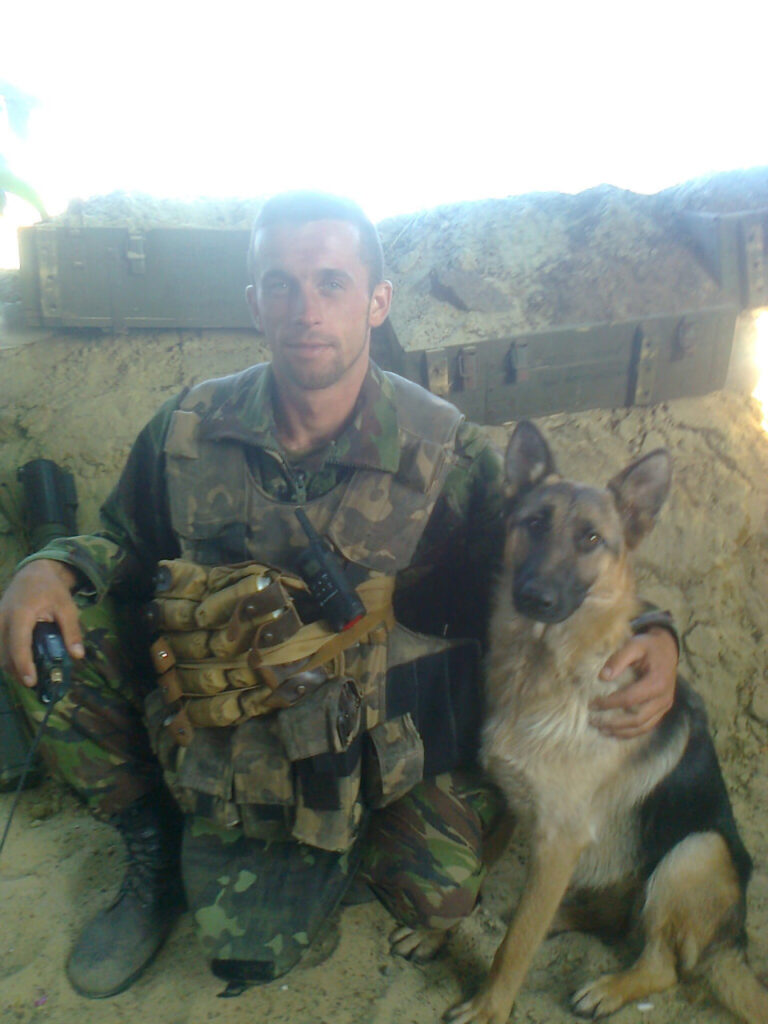
Junior Sergeant B. Dyshko, 80th Airmobile Brigade, with German Shepherd Lora who befriended soldiers and accompanied them on duty, Heorhiivka, late July 2014
“Honestly, every day, every hour that you were still alive and well at the airport was already an event of a sort. I don’t remember a single day when we would have peace and quiet for 24 hours in a row. Every day, every night it was either another attack or massive shelling. Every day there was shooting, we were delivered ammo, someone had to unload it, someone was wounded… Guys attacking at one place, someone 300th at another, a 200th elsewhere… So many events that it’s hard to really single out one particular event.
I had one [such a bright] event – when my father arrived at the airport. That was quite an event for me. We had been shooting all night, and in the morning, I was resting up, sleeping. Then an officer from the battery came and told me, “Get up, your dad is here!” That’s what I remember well.”
“We arrived at the airport. I called for my son. He stood there, looking into my eyes, and didn’t recognize me. His eyes were filled with death, emptiness, darkness… I shook him, hugged him, and he snapped out of it, he was so happy: “Dad’s here!”
… When we were retreating [on the day of the airport assault], they fired the Grads, shells landing just 20–30 meters away. He fell – I fell on top. He kept asking, “Dad, why are you lying on top of me?!…””
“These guys were protecting us, and we had a chance to help them. In the military system, everyone must do their job. For a doctor to work adequately and provide proper help, they need to be in a protected building, in relative safety. It’s a symbiosis of a sort.
… This was a brotherhood in arms, where you saw anyone in uniform with a gun as a brother, no exaggeration here. This is an unmatched feeling. You won’t see anything like this anywhere else but at war. When you’re at war, it’s like with small kids – they see no gray, only black and white, good and evil. Adults live in shades of gray. It wasn’t like that here – we lived by these childlike concepts: there were absolute brothers and absolute enemies. And that was it. This feeling makes you recall the war in a positive light. Everyone is equal here; everyone is the same because you are all in the same conditions. You can go to the toilet and never come back. And it can be anyone – commander or soldier. Social differences just vanish. That’s probably why so many soldiers coming back from the war want to return. Because they face the fact that everything is different in civilian life. But there, everything was honest, fair. And that’s what I remember most about the airport. It was an honest place.”
About the assault on August 31 and the retreat from the airport
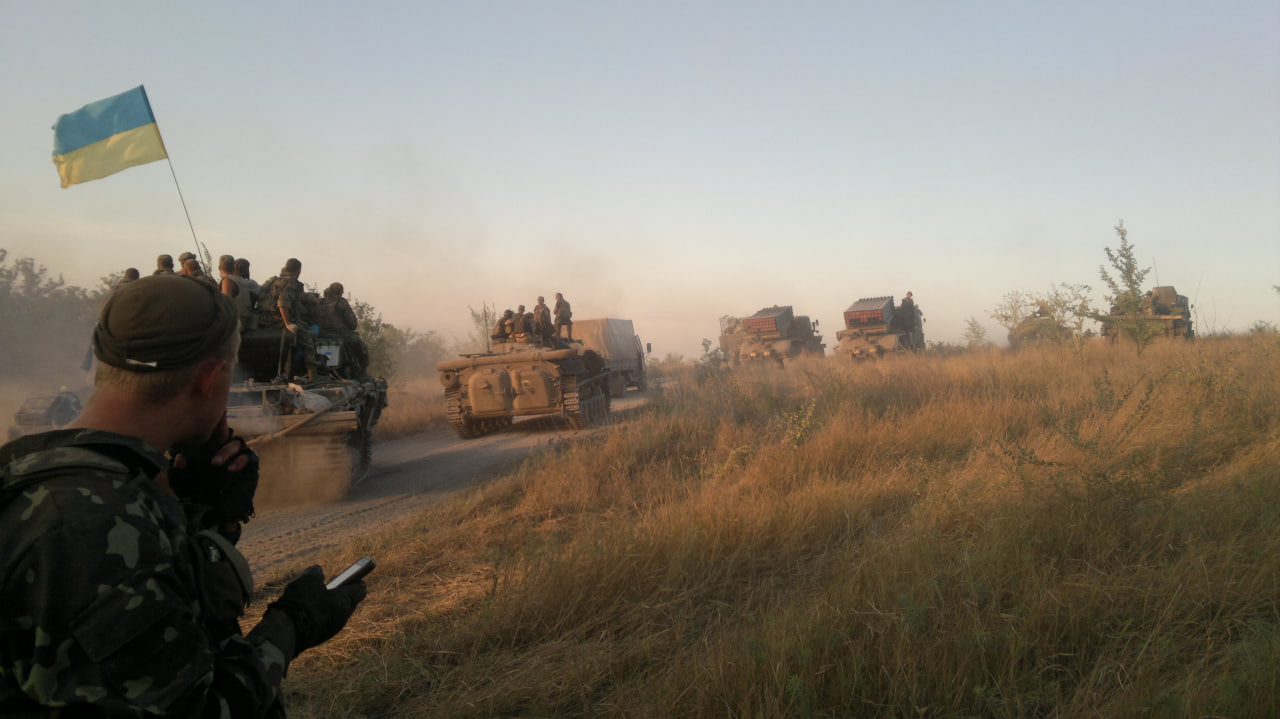
Final withdrawal of Ukrainian troops from the airport area, September 1, 2014
“That morning, we heard yells: “Tanks in the airport!” We knew they weren’t our tanks. We were encircled. We were ready for this, of course, but not that ready. We were still hoping to get some kind of backup or something. We thought, maybe the command would come up with some sort of a plan. We were already reported to be surrounded, but nothing, no help arrived.
Tanks went in from the terminal, from Post 1, from Novosvitlivka, and from Post 3. They were moving in on us in a semicircle. They set up blocking detachments in the tree lines to make sure we couldn’t escape.”
“…Around 9 a.m., General Kolesnik contacted me. He asked, “Andrii, what’s the decision?”
I said that the first option was to hold out until nightfall, to retreat under the cover of darkness.
Daytime retreat was impossible, there were open fields all around – we would be in full view for the enemy. The second option was surrender, but this… I’d rather shoot myself. You’re no commander anymore, it’s a lifetime of disgrace, for you and your ancestors too. As a commander, you’re dead. I mean, not just as a serviceman, but as a citizen of your country. But surrendering would save lives. And not just one life – a whole hundred of them. I told [General Kolesnik]: “If you don’t ditch us here, if you give us artillery support, we will hold until dark.” And we immediately started giving target coordinates outside the airport.”
“At one point, the guys reported hearing the Russians say, “Fuck this!” Then, they started to pull back bit by bit. The guys realized those words they heard weren’t for nothing. This encouraged us a little and gave us the strength to keep holding on. We slowly started retreating from the airport. But on our side, the fight went on. They tried to break through, but we held the ground. The enemy knew their forces had already entered from the south, but they couldn’t break through on our side, so they just kept putting on pressure.
We were passing ammo simply by tossing it from trench to trench. We would just pour as much as we could into a backpack and toss it over. We would take gas mask pouches, put the rounds there, spin the pouches, and toss them to each other. That’s how we kept the guys supplied. Artillery kept firing on both sides. Once they entered the airport, the shelling ceased, and a close-range combat began. Tanks operated within 200 meters, targeting our covers. Whenever they were able to spot where we were shooting from, they would shower that spot with everything they’d got.
There were helicopters, [we] tried to shoot them down. Shells flying, stuff exploding, no end in sight. Until we heard those words and realized they were retreating. But we knew they wouldn’t stop there. They would regroup and come back, especially having seen the area now.”
“When the assault began, there were many wounded, we were putting them everywhere… Some didn’t even make it to the bunker… The dead were taken away [by vehicles]. Before that, we were putting them in the corridor [of the bunker]. No toilet breaks, we couldn’t even get out.
They were sending the wounded down to me from that line, I was standing on the bunker stairs, sometimes I would go up, and they would tell me: “Doc! Don’t go up there!” The wounded were taken to the stairs. If the wound was light, some painkillers and bandaging would do, and back to the position! Some guys were concussed, they were screaming: “My head hurts! My head hurts!” I would put them on a drip, 40 minutes, they’re back to their senses and were like: “That’s it! I’m going! My guys are out there!” And they would go back to their positions.”
“At about 3 o’clock, we moved to the positions of the artillery division and headed towards Lutuhyne. What stuck with me during this departure – it wasn’t a chaotic retreat, it was somewhat organized, with the units lining up and all. Those at Post 8 left in an organized manner.
What I remember most is that people (civilians) still didn’t fully understand what was happening: when we were passing through Heorhiivka, they waved at us and greeted us, but they didn’t realize that we weren’t just retreating from the airport already [at that time]… Of course, our mood was very downcast.”
About the defense of Lugansk Airport
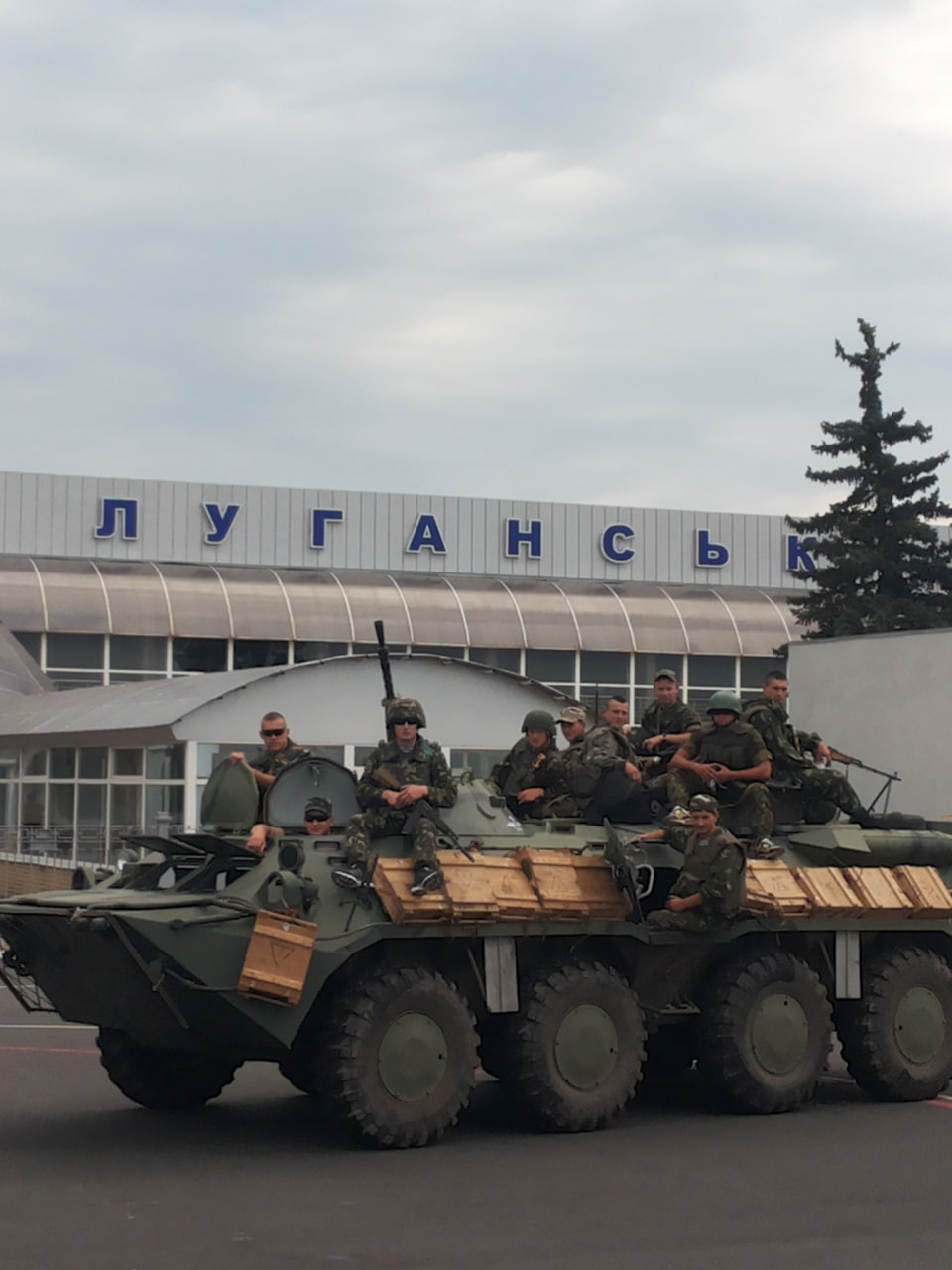
Soldiers of the 2nd Company of the 1st Battalion of the 80th Airmobile Brigade, who were on duty on the eastern side of the runway, May 2014
“When we retreated from Luhansk Airport, we weren’t squeezed out – we just left it. There was no need to hold it as a strategic point anymore. … You can see what was left of it in the pictures. When we were leaving, it was burning, all of it. Like, there’s an alley of trees, and they’re all on fire. How can you set live trees on fire? But they were burning. Like, when you’re walking, and there’s nowhere to step. And when you walk out at night, you fall into a crater, or stumble over bits and pieces of metal scraps and still fall, or bump your foot on those bricks on the road. The main airport road was all craters and fallen trees. It was a nightmare. Remember those movies about the so-called Great Patriotic War, when they show Stalingrad? Well, they are not even close. You can’t imitate anything like that, no such special effects invented…”
“The number of wounded and killed they had was simply insane. After taking the airport, one of their sep commanders (he’s now dead) gave an interview and said, regarding the events near the bunker: “There were about 17 people there [Ukrainian military]… they are not humans, they are beasts! If I had them, I would already be in Lviv!” Even with the number of men he had, they still were no match for our guys around the bunker.
… When we were in Novosvitlivka, no one expected to come out alive. But when we got to the airport on the last day… I burned my passport, broke and buried my driver’s license. Especially when we called artillery fire on ourselves, there was no hope left. We wanted to make every effort to take as many Russians with us as possible!”
“The fact that intense battles broke out there when the number of guys who remained in Luhansk Airport at that moment to fight… I can’t really name the numbers, but compared to the enemy, the difference was huge.
The fight that the guys gave on the last day – I think no one had given the Russians so much hell as in Luhansk Airport. Nagorno-Karabakh, Georgia, Chechnya… well, maybe Chechnya. And when they found out how many of us really were there, at the airport, during the assault, they were shocked! Considering the huge losses they suffered there.”
“The 80th Brigade was the first to enter and the last to leave. Donetsk Airport was partially under the seps and partially under the 95th Brigade… But the seps entered Luhansk Airport only on the last day. They hadn’t even had such a chance before!”
“I’d really want to get back there some day. To drive on those roads we traveled under fire, to come to those ruins. First, to sprinkle them with the blood of our enemy, and later, when our land is free again, to lay flowers at the place where the terminal was, light a candle. Kneel, take off the helmet, and pray for those who stayed there forever. Almost every night, I dream of these battles. I’ve never wanted to return anywhere as much as I do to that airport…”
Before leaving, the fighters left a message in Luhansk Airport: “We’ll be back.”